|
Document
reference: |
370161 | 05|01 | A |
|
Information
class: |
Standard |
|
This document is issued for the party which commissioned it and for
specific purposes connected with the above-captioned project only. It should
not be relied upon by any other party or used for any other purpose. We accept no responsibility for the consequences of this document
being relied upon by any other party, or being used for any other purpose,
or containing any error or omission which is due to an error or omission in
data supplied to us by other parties. This document contains confidential information and proprietary
intellectual property. It should not be shown to other parties without
consent from us and from the party which commissioned it. |
|
This report has been
prepared solely for use by the party which commissioned it (the ‘Client’) in
connection with the captioned project. It should not be used for any other
purpose. No person other than the Client or any party who has expressly
agreed terms of reliance with us (the ‘Recipient(s)’) may rely on the
content, information or any views expressed in the report. We accept no duty
of care, responsibility or liability to any other recipient of this document.
This report is confidential and contains proprietary intellectual property. No representation, warranty or
undertaking, express or implied, is made and no responsibility or liability
is accepted by us to any party other than the Client or any Recipient(s), as
to the accuracy or completeness of the information contained in this report.
For the avoidance of doubt this report does not in any way purport to include
any legal, insurance or financial advice or opinion. We disclaim all and any liability
whether arising in tort or contract or otherwise which it might otherwise
have to any party other than the Client or the Recipient(s), in respect of
this report, or any information attributed to it. We accept no responsibility for
any error or omission in the report which is due to an error or omission in
data, information or statements supplied to us by other parties including the
client (‘Data’). We have not independently verified such Data and have
assumed it to be accurate, complete, reliable and current as of the date of
such information. Forecasts presented in this
document were prepared using Data and the report is dependent or based on
Data. Inevitably, some of the assumptions used to develop the forecasts will
not be realised and unanticipated events and circumstances may occur. Consequently
Mott MacDonald does not guarantee or warrant the conclusions contained in the
report as there are likely to be differences between the forecasts and the
actual results and those differences may be material. While we consider that
the information and opinions given in this report are sound all parties must
rely on their own skill and judgement when making use of it. Under no circumstances may this
report or any extract or summary thereof be used in connection with any
public or private securities offering including any related memorandum or
prospectus for any securities offering or stock exchange listing or announcement. |
Contents
1.3
Environmental Status in the reporting period
1.4
Summary of EM&A Requirements
2
Impact Monitoring Methodology
3.1
Impact Monitoring Schedule
3.2
Results of Impact Monitoring
4.2
Monitoring of Herpetofauna
4.3
Monitoring of Dragonflies and Butterflies
4.5
Monitoring of Water Quality
5.2
Construction Phase Audit Summary
6
Environmental Site Inspection and Audit
6.2
Solid and Liquid Waste Management Status
6.3
Status of Environmental Licences and Permits
6.4
Recommended Mitigation Measures 39
7
Report on Non-compliance, Complaints, Notifications of Summons and
Successful Prosecutions
7.1
Record of non-compliance of Action and Limit Levels
7.2
Record on Environmental Complaints Received
7.3
Record on Notifications of Summons and Successful Prosecution
7.4
Review of Reasons for and Implications of Non-compliance, Complaints,
Summons and Prosecutions
7.6
Cumulative Statistics for Complaints, Notifications of Summons and
Successful Prosecutions
8.1
Site Preparatory Works and Construction Works for the Coming Month
8.2
Key Issues for the Coming Months
8.3
Monitoring Schedule for the Coming Month
8.4
Conclusions and Recommendations 44
B. Tentative
Construction Programme (not used)
C. Action
and Limit Levels for Construction Phase
D. Event
and Action Plan for Air Quality, Noise, Water Quality and Landscape &
Visual
F. Graphical
Plots of the Monitoring Results
G. Weather
Conditions during the Monitoring Period
H. Ecological
Monitoring Conducted
I.
Summary of Bird Surveys conducted
J. Summary
of Herpetofauna, Mammal and Insect Surveys Conducted
K. Summary
of Water Quality Monitoring associated with Ecological Monitoring conducted
L. Environmental
Mitigation Measures – Implementation Status
M. Landscape
and Visual Audit Photos
Tables
Table 1.1: Summary of Impact EM&A Requirements
Table 1.2: Environmental Monitoring and Audit Schedule
for the Reporting Month
Table 2.1: Air Quality Monitoring Parameters, Frequency
and Duration
Table 2.2: Air Monitoring Stations
Table 2.3: TSP Monitoring Equipment
Table 2.4: Noise Monitoring Parameters, Frequency and
Duration
Table 2.5: Noise Monitoring Stations
Table 2.6: Noise Monitoring Equipment
Table 2.7: Water Quality Monitoring Parameters, Frequency
and Duration
Table 2.8: Water Quality Monitoring Stations
Table 2.9: Water Quality Monitoring Equipment
Table 2.10: Analytical Methods applied to Water Quality
Samples
Table 2.11: Detection Limits for Water Quality
Determinants
Table 2.13: Construction and Operation Phase Audit
Checklist
Table 2.14: Proposed Construction Phase Mitigation
Measures
Table 2.15: Proposed Operation Phase Mitigation Measures
Table 3.1: Summary of 1-hour TSP Monitoring Results
Table 3.2: Summary of 24-hour TSP Monitoring Results
Table 3.3: Summary of Construction Noise Monitoring
Results
Table 3.4: Summary of Water Quality Monitoring Results
Table 4.1: Summary of Ecological Monitoring in WRA and
Survey Area under EM&A Manual
Table 5.1: Construction and Operation Phase Audit Summary
Table 6.1: Summary of Site Inspections and
Recommendations
Table 6.2: Status of Environmental Submissions, Licences
and Permits
Table 7.1: Summary of Exceedances in Water Quality
Table 7.2: Statistics for Complaints, Notifications of
Summons and Successful Prosecution
Table 8.1: Tentative Environmental Monitoring and Audit
Schedule for the Next Reporting Month 44
Figures
Figure
1.1 General Layout Plan of the
Project Site
Figure
2.1 Locations of Air Quality
Monitoring Stations
Figure
2.2 Locations of Noise Monitoring
Stations
Figure
2.3 Locations of Water Quality
Monitoring Stations
Figure
4.1 Survey Area and Transect Walked
Figure
4.2 Water Quality Monitoring
Locations for Ecological Monitoring
Mott MacDonald Hong Kong Ltd.
(“MMHK”) has been commissioned to undertake the Environmental Team (ET)
services to carry out environmental monitoring and audit (EM&A) for both
pre-construction and construction phases of the Proposed Comprehensive Development
at Wo Shang Wai, Yuen Long.
This is the 172nd
EM&A report submitted under the Condition 4.5 of Environmental Permit No.
EP-311/2008/E. This report summarises the findings on EM&A during the
period from 1 to 31 August 2024.
Exceedance of Action and Limit
Levels
There was no breach of Action or
Limit levels for Air Quality (1-hr TSP and 24-hr TSP) and Noise level (as Leq)
in the reporting month.
During August 2024, a total of one Action Level exceedance of DO, 17
Limit Level exceedances of DO and two Action Level exceedances of pH were
observed for water quality. Two Action Level exceedances of pH and 13 Limit
Level exceedances of DO were recorded at MP3; one Limit Level exceedance of DO
was recorded at MP4; three Limit Level exceedances of DO and one action level
exceedance of DO were recorded at MP6.
Implementation of Mitigation
Measures
Site audits were carried out on 1,
9, 15, 23 and 30 August 2024 to confirm the implementation measures undertaken
by the Contractor in the reporting month. The outcomes of the site audits are
presented in Section 6 and the status of implementation of mitigation measures
in the site is shown in Appendix
L.
Record of Complaints
There was no record of complaints
received in the reporting month.
Future Key Issues
Site works scheduled to be
commissioned in the coming three months include regular maintenance work for
the Wetland Restoration Area including adjusting the water level, if required,
and removal of unwanted species in the pond. No major heavy construction works
will be carried out. Potential environmental impacts due to the activities,
including air quality, noise, water quality, ecology and landscape and visual,
will be monitored.
Environmental mitigation measures
will be implemented on site as recommended and weekly site audits will be
carried out to ensure that the environmental conditions are acceptable.
1 Introduction
1.1 Introduction
In March 2005, the Project
Proponent, Profit Point Enterprises Limited, acquired the development site at
Wo Shang Wai in Yuen Long. An Environmental Impact Assessment (EIA) was then
carried out and approved under the EIA Ordinance (EIAO), and the Environmental
Permit (EP-311/2008) for construction of the comprehensive development in Wo
Shang Wai was first granted by EPD on 9 September 2008 and has been
subsequently varied, with the current version (EP-311/2008/E) issued by EPD on
19 December 2017.
The Project involves the residential
development and associated infrastructure and wetland restoration area and
linear landscape area. The construction works under the Environmental Permit
commenced on 12 May 2010. The site formation construction works of the Wetland
Restoration Area (hereafter WRA) were completed on 15 November 2010 and the WRA
was established by October 2012, within 30 months from the commencement of
construction as stipulated in the EP. This indicated that planting works as
scheduled in the approved Wetland Restoration and Creation Scheme (WRCS; Nov
2009) were complete, except along the western and southern boundary where the
planting is affected by the existing site boundary and noise barrier, and for
which a Variation to Environmental Permit (EP-311/2008/C) to defer planting at
the location was approved. Consequently, EP (EP-311/2008/D) including specific
mitigation measures to minimise certain identified noise impacts during the
operation phase was approved. The current valid EP (EP-311/2008/E) comprises
varied conditions for the implementation and maintenance of visual and
landscape measures, and for the implementation of noise mitigation
measures.
Mott MacDonald Hong Kong Ltd.
(“MMHK”) has been commissioned to undertake the Environmental Team (ET)
services to carry out environmental monitoring and audit (EM&A) for both
pre-construction and construction phases of the Proposed Comprehensive Development
at Wo Shang Wai, Yuen Long.
According to the EP Condition 4.5,
the monthly EM&A Report shall be submitted to the Director within two weeks
after the end of the reporting month. This report summarises the findings
during the period from 1 to 31 August 2024.
1.2 Project Organization
The organisation chart and lines of
communication with respect to the on-site environmental management structure
together with the contact information of the key personnel are shown in Appendix
A.
1.3 Environmental Status in the
reporting period
During the
reporting month, Project works undertaken include:
● General site maintenance work
● Regular maintenance work for the
Wetland Restoration Area (including monitoring the water level and removal of
unwanted species in the pond), as indicated in Section 4.6.
There were no heavy construction
works carried out. The general layout plan of the Project site is shown in Figure
1.1.
1.4 Summary of EM&A Requirements
The EM&A programme requires
environmental monitoring of air quality, noise, water quality, ecology and
landscape and visual as specified in the approved EM&A Manual.
A summary
of impact EM&A requirements is presented in Table
1.1 below:
Table
1.1: Summary of Impact EM&A Requirements
|
Parameters |
Descriptions |
Locations |
Frequencies |
|
Air
Quality |
24-Hour
TSP |
ASR1,
ASR2A, ASR3, ASR4 |
Once
every 6 days |
|
1-Hour
TSP |
ASR1,
ASR2A, ASR3, ASR4 |
3
times every 6 days |
|
|
Noise |
Leq(30min),
L90, L10 (dB(A)) |
NSR1,
NSR3, NSR5, NSR7 |
Weekly |
|
Water
Quality |
Dissolved
Oxygen (DO), temperature, pH, suspended solids (SS) and Biochemical Oxygen
Demand (BOD) |
MP1
to MP6 |
3
days per week |
|
Ecology |
Birds |
Within
the Project Area and Assessment Area of 500m |
Weekly |
|
Dragonflies
and Butterflies |
Within
the Project Area and Assessment Area of 500m |
Once
per month during Mar and Sep to Nov, and twice per month during Apr to Aug |
|
|
Herpetofauna |
Within
the Project Area and Assessment Area of 500m |
Daytime:
Once per month during Apr to Nov Night-time:
Once per month during Mar to Aug |
|
|
Water
quality of Wetland Restoration Area (WRA) |
WRA |
After
filling of WRA with water, monthly for in situ water quality and every six
months (end of wet season and end of dry season) for laboratory testing |
|
|
Site
Inspections |
Within
the Project Area and Assessment Area of 500m |
Weekly |
|
|
Landscape
and Visual |
Auditing
of protection of existing trees, the transplanting of existing trees, the
creation of new wetland, the planting of new trees and shrubs and other
landscape and visual mitigation measures |
CM1
to CM10 and OM1 to OM7 within the Project Area |
Site
inspections once every two weeks during construction phase; once every two
months during operational phase |
The
Environmental Quality Performance Limits for air quality, noise and water
quality are shown in Appendix
C.
The Event and Action Plan for air
quality, noise, water quality and Landscape & Visual are shown in Appendix
D.
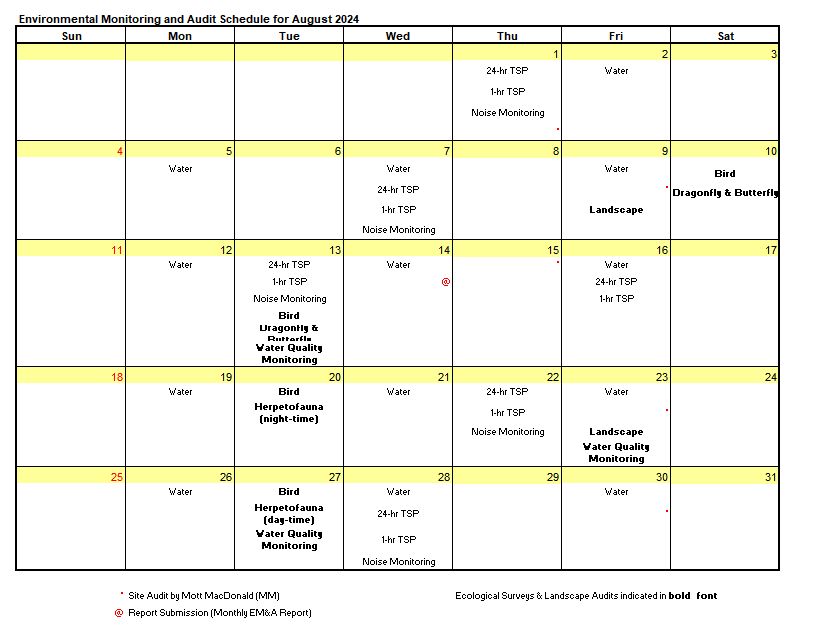
The monitoring schedule for the
reporting month is shown in Table 1.2 as
follows.
Table 1.2: Environmental Monitoring and Audit
Schedule for the Reporting Month
2
Impact Monitoring Methodology
2.1
Introduction
For air quality, construction noise
and water quality, ecology, landscape and visual monitoring methodology,
including the monitoring locations, monitoring equipment used, monitoring
parameters, and frequency and duration, etc., are detailed in this Chapter.
2.2
Air
Quality
2.2.1 Monitoring Parameters, Frequency and Duration
In accordance with the EM&A
Manual, 1-hour and 24-hour TSP levels monitoring are to be conducted during the
construction phase. Table 2.1 summarizes the
monitoring parameters, frequency and duration of air quality monitoring.
Table
2.1: Air Quality Monitoring Parameters, Frequency and Duration
|
Monitoring
Stations |
Parameter |
Frequency
and Duration |
|
ASR1,
ASR2A, ASR3 & ASR4 |
24-hour
TSP |
At
least once in every six-days |
|
1-hour
TSP |
3
times every six-days |
2.2.2 Monitoring Locations
The four air quality monitoring
stations were established in the EM&A manual and were slightly adjusted
during the baseline monitoring phase. Locations of the agreed air quality
monitoring stations are listed in Table 2.2 and
as shown in Figure
2.1.
Table
2.2: Air Monitoring Stations
|
Monitoring
Stations |
Locations |
|
ASR1 |
Guard
house outside House No. 1, Ventura Avenue, Royal Palms* |
|
ASR2A |
At
the rooftop of refuse collection point, which is located at the southwest of
the project area |
|
ASR3 |
At
the commercial centre at Palm Springs, which is located at the south of the
project area |
|
ASR4 |
Outside
works site entrance* |
*Note: Relocation of ASR1 and ASR4
were from 5 June 2018 as the previous locations were within the Project
construction site. All monitoring data at ASR1 and ASR4 from June 2018 is
measured at the new monitoring locations.
2.2.3 Monitoring Equipment
Continuous 24-hour TSP air quality
monitoring is conducted using High Volume Sampler (HVS) (Model: GMWS-2310
Accu-vol). The HVS meets all the requirements of the EM&A Manual. Portable
direct reading dust meters were used to carry out the 1-hour TSP monitoring. Table 2.3
summarizes the equipment used in the impact air quality monitoring.
Table
2.3: TSP Monitoring Equipment
|
Equipment |
Model |
|
24-hr TSP monitoring |
|
|
High
Volume Sampler |
GMWS
2310 Accu-vol |
|
Calibrator |
TE-5025A |
|
1-hr TSP monitoring |
|
|
Portable
direct reading dust meter |
Sibata
LD-3B Laser Dust Monitor |
2.2.4 Monitoring Methodology
2.2.4.1
24-hour TSP Monitoring
Installation
The HVS was installed in the
vicinity of the air sensitive receiver. The following criteria were
considered in the installation of the HVS.
● A horizontal platform with
appropriate support to secure the sampler against gusty wind was provided.
● The distance between the HVS and any
obstacles, such as buildings, was at least twice the height that the obstacle
protrudes above the HVS.
● A minimum of two metres separation
from walls, parapets and penthouse was required for rooftop sampler.
● A minimum of two metres separation
from any supporting structure, measured horizontally was required.
● No furnace or incinerator flues or
building vent were nearby.
● Airflow around the sampler was
unrestricted.
● The sampler has been more than 20
metres from any drip line.
● Permission was obtained to set up
the samplers and to obtain access to the monitoring stations.
● A secured supply of electricity is
needed to operate the samplers.
Preparation
of Filter Papers
● Glass fibre filters were labelled
and sufficient filters that were clean and without pinholes were selected.
● All filters were equilibrated in the
conditioning environment for 24 hours before weighing. The conditioning
environment temperature was around 25 °C and not variable by more than ±3 °C
with relative humidity (RH) < 50% and was not variable by more than
±5%. A convenient working RH was 40%.
Field
Monitoring
● The power supply was checked to
ensure the HVS works properly.
● The filter holder and the area
surrounding the filter were cleaned.
● The filter holder was removed by
loosening the four bolts and a new filter, with stamped number upward, on a
supporting screen was aligned carefully.
● The filter was properly aligned on
the screen so that the gasket formed an airtight seal on the outer edges of the
filter.
● The swing bolts were fastened to
hold the filter holder down to the frame. The pressure applied should be
sufficient to avoid air leakage at the edges.
● The shelter lid was closed and was
secured with the aluminium strip.
● The HVS was warmed-up for about 5
minutes to establish run-temperature conditions.
● A new flow rate record sheet was set
into the flow recorder.
● The flow rate of the HVS was checked
and adjusted at around 1.1 m3/min. The range specified in the
EM&A Manual was between 0.6-1.7 m3/min.
● The programmable timer was set for a
sampling period of 24 hrs + 1 hr, and the starting time, weather condition and
the filter number were recorded.
● The initial elapsed time was
recorded.
● At the end of sampling, the sampled
filter was removed carefully and folded in half-length so that only surfaces
with collected particulate matter were in contact.
● It was then placed in a clean
plastic envelope and sealed.
● All monitoring information was
recorded on a standard data sheet.
● Filters were sent to a HOKLAS
accredited laboratory for analysis.
Maintenance
and Calibration
● The HVS and its accessories are
maintained in good working condition, such as replacing motor brushes routinely
and checking electrical wiring to ensure a continuous power supply.
● HVSs were calibrated at two-month
intervals.
● Calibration records for HVSs are
shown in Appendix
E.
2.2.4.2
1-hour TSP Monitoring
Field
Monitoring
The measuring procedures of the
1-hour dust meter are in accordance with the Manufacturer’s Instruction Manual
as follows:
● Set POWER to “ON”, push BATTERY
button, make sure that the meter’s indicator is in the range with a red line
and allow the instrument to stand for about 3 minutes (Then, the air sampling
inlet has been capped).
● Push the knob at MEASURE position.
● Push “O-ADJ” button. (Then meter’s
indication is 0).
● Push the knob at SENSI ADJ position
and set the meter’s indication to S value described on the Test Report using
the trimmer for SENSI ADJ.
● Pull out the knob and return it to
MEASURE position.
● Push “START” button.
Maintenance
and Calibration
● The 1-hour dust meter would be
checked at 3-month intervals and calibrated at 1-year intervals throughout all
stages of the air quality monitoring.
2.3
Construction
Noise
2.3.1 Monitoring Parameters, Frequency and Duration
Following the requirements in the
EM&A Manual for noise, noise monitoring has to be carried out during the
construction phase. Continuous noise monitoring for the A-weighted levels Leq(30 min),
L10 and L90 is undertaken once per every week.
Table 2.4 summarizes the monitoring
parameters, frequency and duration of air quality monitoring.
Table
2.4: Noise Monitoring Parameters, Frequency and Duration
|
Monitoring
Stations |
Parameter |
Frequency
and Duration |
|
NSR1,
NSR3, NSR5, NSR7 |
Leq(30min),
L90, L10 (dB(A)) |
Once every
week |
2.3.2 Monitoring Locations
The four noise quality monitoring
stations were established in the EM&A manual and were slightly adjusted
during the baseline monitoring phase. Locations of the agreed noise quality
monitoring stations are listed in Table 2.5 and
as shown in Figure
2.2.
Table
2.5: Noise Monitoring Stations
|
Monitoring Stations |
Locations |
Type of measurement |
|
NSR1 |
Noise
monitoring equipment was set up near the boundary wall at Palm Springs |
Free
field |
|
NSR3 |
The monitoring station was located next to
the guard house at Palm Spring |
Façade |
|
NSR5 |
Outside House No. 1, Ventura Avenue, Royal
Palms* |
Façade |
|
NSR7 |
The monitoring station was located near the
boundary wall of the house of Mai Po San Tsuen |
Free
field |
*Note: Relocation of NSR5 was from 5
June 2018 as the previous location was within the Project construction site.
All monitoring data at NSR5 from June 2018 is measured at the new monitoring
location.
2.3.3 Monitoring Equipment
Integrating
Sound Level Meter was used for noise monitoring. It is a Type 1 sound level
meter capable of giving a continuous readout of the noise level readings
including equivalent continuous sound pressure level (Leq) and
percentile sound pressure level (Lx). They comply with International
Electrotechnical Commission Publications 651:1979 (Type 1) and 804:1985 (Type
1). Table 2.6 summarizes the noise monitoring
equipment model being used.
Table
2.6: Noise Monitoring Equipment
|
Equipment
|
Model |
|
Integrating
Sound Level Meter |
Rion
NL-52 |
|
Calibrator |
Larson
Davis CAL200 |
2.3.4 Monitoring Methodology
Field
Monitoring
● The Sound Level Meter was set on a
tripod at a height of at least 1.2 m above the ground.
● Façade and free-field measurements
were made at the monitoring locations.
● The battery condition was checked to
ensure the correct functioning of the meter.
● Parameters such as frequency
weighting, the time weighting and the measurement time were set as follows:
– frequency weighting: A
– time weighting: Fast
– time measurement: 30 minutes
intervals (between 07:00 and 19:00)
● Prior to and after each noise
measurement, the meter was calibrated using a Calibrator for 94 dB at 1
kHz. If the difference in the calibration level before and after
measurement was more than 1 dB, the measurement would be considered invalid has
to be repeated after re-calibration or repair of the equipment.
● During the monitoring period, the Leq,
L10 and L90 were recorded. In addition, any site
observations and noise sources were recorded on a standard record sheet.
Maintenance
and Calibration
● The microphone head of the sound
level meter and calibrator is cleaned with soft cloth at quarterly intervals.
● The meter and calibrator are sent to
the supplier or HOKLAS laboratory to check and calibrate at yearly intervals.
● Calibration records are shown in Appendix
E.
2.4
Water
Quality
2.4.1 Monitoring Parameters, Frequency and Duration
In accordance with the requirements
in the EM&A Manual for water quality, water quality parameters including
Dissolved Oxygen (DO), temperature, pH, turbidity, suspended solids (SS) and
Biochemical Oxygen Demand (BOD) have to be monitored at designated monitoring
stations during construction of the Project. DO, temperature and pH were
measured in-situ whereas SS and BOD were analysed in a laboratory. The
measurements should be taken at all designated monitoring stations, three days
per week. The interval between any two sets of monitoring was not less than 36
hours. Table 2.7 summarizes the monitoring
parameters, frequency and duration of water quality monitoring.
Table
2.7: Water Quality Monitoring Parameters, Frequency and Duration
|
Monitoring
Stations |
Parameter |
Frequency
and Duration |
|
MP1,
MP2, MP3, MP4, MP5 & MP6 |
DO,
temperature, pH, SS, turbidity, BOD |
Three
days every week |
2.4.2 Monitoring Locations
The six water quality monitoring
stations were established in the EM&A manual. Locations of the agreed water
quality monitoring stations are listed in Table 2.8
and as shown in Figure
2.3.
Table
2.8: Water Quality Monitoring Stations
|
Monitoring
Stations |
Easting |
Northing |
|
MP1* |
838
730.50 |
822
862.25 |
|
MP2* |
838
933.26 |
823
247.41 |
|
MP3 |
839
107.17 |
823 596.84 |
|
MP4 |
839
286.14 |
823
638.55 |
|
MP5 |
839
134.35 |
823
722.99 |
|
MP6 |
839
063.02 |
823
842.25 |
*Note: The water quality impact
monitoring at MP1 and MP2 have been terminated since July 2012 due to
withdrawal of access right from landowner.
2.4.3 Monitoring Equipment
The Water Quality Monitoring
Equipment and Analytical Methods applied to Water Quality Samples are given in Table 2.9 and Table 2.10
respectively. Details of which are discussed as follows.
Table
2.9: Water Quality Monitoring Equipment
|
Equipment |
Model |
Equipment/
Serial Number |
|
Conductivity,
Dissolved oxygen, pH, Salinity and Temperature Measuring Meter, Turbidity |
YSI
ProDSS |
21K101468 15M100005 21G105356 16H104233 |
|
Global
Positioning System (GPS) |
Garmin
eTrex Vista |
ENO
007 |
Table
2.10: Analytical Methods applied to Water Quality Samples
|
Determinant,
unit |
Standard
Method |
|
Total
Suspended Solids, mg/L |
In
house method based on APHA 2540D; ALS Method Code: EA-025 |
|
Biochemical
Oxygen Demand (BOD), mg/L |
In
house method based on APHA 5210B; ALS Method Code: EP-030 |
All in-situ monitoring instruments
were checked, calibrated and certified by a laboratory accredited under HOKLAS
or any other international accreditation scheme before use.
Dissolved
Oxygen (DO), Temperature, pH and Turbidity measuring equipment
A portable, weatherproof
multiparameter instrument (YSL ProDSS) was used in the monitoring. It can be
capable for measuring dissolved oxygen (DO), temperature, pH and turbidity
simultaneously with the following limits:
● a dissolved oxygen level in the range
of 0-50 mg/L and 0-500 % saturation;
● a temperature of -5 to 70 degrees
Celsius;
● pH value of 0-14 with 0.1 as the
base unit; and
● turbidity between 0-4000 NTU
Global
Positioning System (GPS)
A hand-held GPS navigator (Garmin
eTrex Vista) was used to identify the designated monitoring stations prior to
water sampling.
Suspended
Solids and BOD Measurements (Sample Containers and Storage)
Water samples for SS analysis were
stored in high density polythene bottles with no preservative added, packed in
ice (cooled to 4 ºC without being frozen), delivered to the laboratory, and
analysed as soon as possible after collection. Analysis was carried out in a
HOKLAS accredited laboratory.
2.4.4 Detection Limit
The limits of detection for the
in-situ and laboratory measurements are shown in Table
2.11.
Table
2.11: Detection Limits for Water Quality Determinants
|
Determinant |
Limit
of Detection |
|
Dissolved
Oxygen |
0.1
mg/L |
|
Temperature |
0.1
degree Celsius |
|
pH |
0.01
unit |
|
Turbidity |
0.1
NTU |
|
Suspended
Solids |
2
mg/L |
|
BOD |
2
mg/L |
2.4.5 Monitoring Methodology
In situ
Measurement
All pH meters, DO/ temperature
meters had been checked and calibrated prior to use. Standard buffer solution
of at least two pH levels (either pH 4 and pH 7, or pH 7 and pH 10) had been
used for calibration of the instrument before and after use.
DO meters had been calibrated by a
laboratory accredited under HOKLAS or any other international accreditation
scheme, and subsequently re-calibrated at three-monthly intervals throughout
all stages of the water quality monitoring. Responses of sensors and electrodes
had been checked with certified standard solutions before each use. Wet bulb
calibrations for all DO meters had been carried out before measurement at each
monitoring location. For the on-site calibration of field equipment, BS
1427:2009, "Guide to on-site test methods for the analysis of waters"
had been observed.
Measurements were taken at three
water depths, namely, 1m below water surface, mid-depth and 1m above stream
bed/pond bed, except where the water depth is less that 6m, the mid-depth
station maybe omitted. Should the water depth be less than 3 m, only the
mid-depth station will be monitored.
Replicates in-situ measurements and
samples collected from each independent monitoring event are required for all
parameters to ensure a robust statistically interpretable dataset.
Water
Samples Preparation and Analysis
For collection of water sampling
within the water courses, a 500ml clean plastic beaker was used. After
collection, the water samples were stored in high-density polythene bottles.
The sample container was rinsed with a portion of the water sample. The water
sample was then transferred to the container, labelled with a unique sample ID
and sealed with a screw cap. The water samples were stored in a cool box
maintained at 4 ºC. The water samples were then delivered to a local
HOKLAS-accredited laboratory (ALS) on the same day for analysis.
The testing methods of testing
parameters as recommended by EIA or required by EPD, with the QA/QC results are
in accordance with the requirement of HOKLAS or international accredited
scheme.
The calibration certificates for
equipment used for in-situ monitoring of water quality are attached in Appendix
E.
2.5
Ecology
2.5.1 Monitoring Parameters, Frequency and Duration
Target species and certain other
fauna were monitored within the Project Area and Assessment Area during the
wetland and residential construction phase. This is important to ensure that
any unexpected events or impacts either on- or off-site are quickly identified
so that remedial action can be taken. The groups monitored and frequency
of monitoring are shown in Table 2.12.
Table
2.12: Summary of Construction Phase Ecological Monitoring for the Wo Shang Wai
Wetland Restoration Area (WRA)
|
Species / Parameter |
Construction Phase Ecological Monitoring |
|
Birds |
Weekly
(including Assessment Area) |
|
Dragonflies
and Butterflies |
Once
per month during March and September to November; and twice per month during
April to August |
|
Herpetofauna |
Daytime:
Once per month during April to November; and Night-time:
Once per month during March to August |
|
Water
Quality |
After
filling of WRA with water, monthly for in situ water quality and every six months
(end of the wet season and end of the dry season) for laboratory testing |
|
Site
Inspections |
Weekly |
2.5.2 Monitoring Locations and Methodology
Ecological monitoring locations
during construction phase are shown in Figure
4.1 and the methodology for ecological monitoring is detailed in Section
4.
2.6
Landscape
and Visual
2.6.1 Monitoring Parameters, Frequency and Duration
All measures undertaken by both the
Contractor and the specialist Landscape Sub-Contractor during the construction
phase and first year of the operational phase shall be audited by a Registered
Landscape Architect, as a member of the ET, on a regular basis to ensure
compliance with the intended aims of the measures. Site inspections
should be undertaken at least once every two weeks throughout the construction
period and once every two months during the operational phase.
The broad scope of audit is detailed
below but should also be undertaken with reference to the more specific
checklist provided in Table 2.13 below.
Operational phase auditing will be restricted to the last 12 months of the
establishment works of the landscaping proposals and thus only the items below
concerning this period are relevant to the operational phase.
● The extent of the agreed works area
should be regularly checked during the construction phase. Any trespass by the
Contractor outside the limit of the works, including any damage to existing
trees and woodland shall be noted;
● The progress of the engineering
works should be regularly reviewed on site to identify the earliest practical
opportunities for the landscape works to be undertaken;
● All existing vegetation, streams and
other features within the study area which are not directly affected by the
works are retained and protected;
● The methods of protecting existing
vegetation proposed by the Contractor are acceptable and enforced;
● Preparation, lifting transport and
re-planting operations for any transplanted trees;
● The layout, design and construction
of buildings conforms to requirements specified in the EIA report;
● All landscaping works are carried
out in accordance with the EIA recommendations and with specifications;
● The planting of new trees, shrubs,
groundcover, climbers, grasses and other plans, together with the replanting of
any transplanted trees are carried out properly and within the right season;
● All necessary horticultural
operations and replacement planting are undertaken throughout the Establishment
Period to ensure the healthy establishment and growth of both transplanted
trees and all newly establishment plants.
Table
2.13: Construction and Operation Phase Audit Checklist
|
Area of Works |
Items to be Monitored |
|
Works
Area |
Check
the extent of the Works to ensure that the Works Area is not exceeded the
site boundaries. |
|
Protection
of all trees and woodland blocks to be retained |
Identification
and demarcation of trees / vegetation to be retained, erection of physical
protection (e.g. fencing), monitoring against possible incursion, physical
damage, fire, pollution, surface erosion, etc. |
|
Streams |
Ensure
no run-off into existing streams |
|
Clearance
of existing vegetation |
Identification
and demarcation of trees / vegetation to be cleared, checking of extent of
works to minimize damage, monitoring of adjacent areas against possible
incursion, physical damage, fire, pollution, surface erosion, etc. |
|
Transplanting
of trees |
Identification
and demarcation of trees / vegetation to be transplanted, monitoring of
extent of pruning / lifting works to minimize damage, timing of operations
implementation of all stages of preparatory and translocation works, and
maintenance of transplanted vegetation, etc. |
|
Topsoil
stripping |
Ensuring
existing topsoil is stripped and stored under recognized good practice and is
hydroseeded and regularly turned to prevent anaerobic conditions |
|
New
buildings |
Ensure
that building finishes accord with mitigation proposals with regard to colour
and albedo. |
|
Boundaries |
Ensuring
hoarding are erected as required |
|
Noise
Barrier |
Ensure
noise barrier design accords with the mitigation proposals with regard to
location, materials and finishes. |
|
Night-time
lighting |
Ensuring
night-time lighting is directional, hooded and shielded away from VSRs |
|
Plant
supply |
Monitoring
of operations relating to the supply of specialist plant material (including
the collecting, germination and growth of plants from seed) to ensure that
plants will be available in time to be used within the construction works. |
|
Landscape
and wetland treatments generally |
Check
that wetland, and hard / soft landscape designs conform to intent of
mitigation measures and agreed designs |
|
Soiling,
planting, etc. |
Monitoring
of implementation and maintenance of soiling and planting works against
possible incursion, physical damage, fire, pollution, surface erosion, etc. |
|
Establishment
Works |
Monitoring
of implementation of maintenance operation during Establishment Period |
2.6.2 Monitoring Locations
The monitoring locations should
check against the mitigation measures proposed under the approved Environmental
Impact Assessment, which are summarised as follows in Table
2.14 and Table 2.15:
Table
2.14: Proposed Construction Phase Mitigation Measures
|
ID No. |
Landscape and Visual Mitigation Measures |
|
CM1 |
The
construction area and contractor’s temporary works areas should be minimised
to avoid impacts on adjacent landscape. |
|
CM2 |
Screening
of construction works by hoardings/noise barriers around Works area in
visually unobtrusive colours, to screen Works. |
|
CM3 |
Reduction
of construction period to practical minimum. |
|
CM4 |
Topsoil,
where identified, should be stripped and stored for re-use in the construction
of the soft landscape works, where the soil material meets acceptable
criteria and where practical. The Contract Specification shall include
storage and reuse of topsoil as appropriate. |
|
CM5 |
Hydroseeding
or sheeting of soil stockpiles with visually unobtrusive material (in earth
tone). |
|
CM6 |
Advance
screen planting of noise barriers. |
|
CM7 |
Control
night-time lighting and glare by hooding all lights. |
|
CM8 |
Ensure
no run-off into streams adjacent to Project Area. |
|
CM9 |
Protection
of existing trees on boundary of project area shall be carefully protected
during construction. Detailed Tree Protection Specification shall be
provided in the Contract Specification. Under this specification, the
Contractor shall be required to submit, for approval, a detailed working
method statement for the protection of trees prior to undertaking any works
adjacent to all retained trees, including trees in contractor’s works
areas. (Tree protection measures will be detailed at S16 and Tree Removal
Application stage). |
|
CM10 |
Trees
unavoidably affected by the works shall be transplanted where
practical. Trees should be transplanted straight to their destinations
and not held in a nursery. A detailed Tree Transplanting Specification
shall be provided in the Contract Specification, if applicable. Sufficient
time for necessary tree root and crown preparation periods shall be allowed
in the project programme. |
Table
2.15: Proposed Operation Phase Mitigation Measures
|
ID
No. |
Landscape
Mitigation Measures |
|
OM1 |
Compensatory
Tree Planting for all felled trees shall be provided to the satisfaction of
relevant Government departments. Required numbers and locations of
compensatory trees shall be determined and agreed separately with Government
during the Tree Felling Application process under DEVB TC(W) 7/2015. |
|
OM2 |
A
continuous belt of screen planting along southern perimeter of project area
with fast growing tree species. At least 450 trees capable of reaching
a height > 10m within 10 years should be planted. Planting of the
belt of trees shall be carried out as advance works ahead of other site
formation and building works. |
|
OM3 |
Maximise
soft landscape and amenity water bodies in residential areas of the
development. Approximately 750 trees (of Heavy Standard size) should be
planted. Where space permits, roadside berms should be created. Street
trees should be of species that reach a mature height of no less than 15m. |
|
OM4 |
Maximise
freshwater habitat wetland creation consistent with achieving other
parameters. Minimum 4.74 ha to be provided. Wetlands must have
natural edge profiles with >1m wide emergent zone. No access to the
wetland by residents and all wetlands must be screened from residential
development by a continuous tree screen at interface with residential
development or earth mounding such that disturbance is minimised.
Implementation of the wetland shall be carried out as advance works. |
|
OM5 |
Use
appropriate (visually unobtrusive and non-reflective) building materials and
colours in built structures. |
|
OM6 |
During
detailed design, refine building layout to create a min. 10m wide gap between
buildings north of Wo Shang Wai pond and also two min. 10m wide gaps in the
row of buildings adjacent to Royal Palms. |
|
OM7 |
Streetscape
elements (e.g. paving, signage, street furniture, lighting etc.) shall be
sensitively designed in a manner that responds to the local context and
minimises potential negative landscape and visual impacts. Lighting
units should be directional and minimise unnecessary light spill. |
3.1 Impact Monitoring Schedule
Impact monitoring for air quality
(dust), noise and water quality due to the construction work were undertaken
during the reporting month in compliance with the EM&A manual in the
reporting period. Regular site inspections were carried out on 1, 9, 15, 23 and
30 August 2024 during the reporting month to assess the compliance with
environmental requirements.
3.2
Results of Impact Monitoring
3.2.1 Air Quality Monitoring
3.2.1.1
1-hour TSP
Results of 1-hour TSP at the four
monitoring locations are summarised in Table 3.1.
Graphical plots of the monitoring results are shown in Appendix
F. The weather conditions in the reporting period are provided in Appendix
G.
Table
3.1: Summary of 1-hour TSP Monitoring Results
|
Monitoring Date |
Start Time |
1-hr TSP (mg/m3) |
Range (mg/m3) |
Action Level (mg/m3) |
Limit Level (mg/m3) |
||
|
|
|
|
|||||
|
|
|
1st Result |
2nd Result |
3rd Result |
|
|
|
|
ASR1 |
|
|
|
|
|
|
|
|
01-Aug-24 |
13:21 |
26 |
32 |
24 |
17-59 |
378 |
500 |
|
07-Aug-24 |
13:42 |
21 |
22 |
22 |
|||
|
13-Aug-24 |
09:10 |
17 |
22 |
19 |
|||
|
16-Aug-24 |
09:12 |
21 |
18 |
17 |
|||
|
22-Aug-24 |
09:05 |
25 |
24 |
20 |
|||
|
28-Aug-24 |
08:31 |
46 |
50 |
59 |
|
|
|
|
ASR2A |
|
|
|
|
|
|
|
|
01-Aug-24 |
09:23 |
28 |
26 |
27 |
16-44 |
357 |
500 |
|
07-Aug-24 |
09:21 |
19 |
18 |
22 |
|||
|
13-Aug-24 |
13:07 |
24 |
20 |
21 |
|||
|
16-Aug-24 |
13:15 |
16 |
19 |
18 |
|||
|
22-Aug-24 |
13:04 |
24 |
22 |
19 |
|||
|
28-Aug-24 |
13:10 |
44 |
39 |
38 |
|
|
|
|
ASR3 |
|
|
|
|
|
|
|
|
01-Aug-24 |
09:06 |
27 |
24 |
25 |
15-43 |
358 |
500 |
|
07-Aug-24 |
09:04 |
21 |
22 |
24 |
|||
|
13-Aug-24 |
13:25 |
17 |
18 |
17 |
|||
|
16-Aug-24 |
12:57 |
15 |
15 |
18 |
|||
|
22-Aug-24 |
13:23 |
26 |
24 |
24 |
|||
|
28-Aug-24 |
13:31 |
41 |
42 |
43 |
|
|
|
|
ASR4 |
|
|
|
|
|
|
|
|
01-Aug-24 |
13:01 |
19 |
17 |
17 |
16-35 |
372 |
500 |
|
07-Aug-24 |
13:21 |
25 |
20 |
19 |
|||
|
13-Aug-24 |
09:31 |
20 |
18 |
18 |
|||
|
16-Aug-24 |
08:52 |
16 |
17 |
16 |
|||
|
22-Aug-24 |
09:25 |
29 |
26 |
21 |
|||
|
28-Aug-24 |
08:52 |
35 |
31 |
29 |
|||
3.2.1.2
24-hour TSP
Results of
24-hour TSP at the four monitoring locations are summarised in Graphical plots
of the monitoring results are shown in Appendix
F. The weather conditions in the reporting period are provided in Appendix
G.
Table 3.2: Summary of 24-hour TSP Monitoring
Results
|
Monitoring Date |
Monitoring Results (mg/m3) |
Range (mg/m3) |
Action Level (mg/m3) |
Limit Level (mg/m3) |
|
ASR1 |
|
|
|
|
|
01-Aug-24 |
30 |
18-48 |
226 |
260 |
|
07-Aug-24 |
35 |
|||
|
13-Aug-24 |
32 |
|||
|
16-Aug-24 |
18 |
|||
|
22-Aug-24 |
30 |
|||
|
28-Aug-24 |
48 |
|
|
|
|
ASR2A |
|
|
|
|
|
01-Aug-24 |
36 |
15-39 |
213 |
260 |
|
07-Aug-24 |
29 |
|||
|
13-Aug-24 |
39 |
|||
|
16-Aug-24 |
15 |
|||
|
22-Aug-24 |
31 |
|||
|
28-Aug-24 |
35 |
|
|
|
|
ASR3 |
|
|
|
|
|
01-Aug-24 |
32 |
13-43 |
205 |
260 |
|
07-Aug-24 |
28 |
|||
|
13-Aug-24 |
24 |
|||
|
16-Aug-24 |
13 |
|||
|
22-Aug-24 |
26 |
|||
|
28-Aug-24 |
43 |
|
|
|
|
ASR4 |
|
|
|
|
|
01-Aug-24 |
43 |
22-49 |
237 |
260 |
|
07-Aug-24 |
45 |
|||
|
13-Aug-24 |
40 |
|||
|
16-Aug-24 |
22 |
|||
|
22-Aug-24 |
43 |
|||
|
28-Aug-24 |
49 |
|
|
|
No
exceedance of 1-hour and 24-hour TSP (Action or Limit Level) was recorded in
the reporting period.
3.2.2 Construction Noise Monitoring
The construction noise monitoring
results are summarized in Table 3.3. Graphical
plots of the monitoring data are shown in Appendix
F. The weather conditions in the reporting period are provided in Appendix
G.
Table
3.3: Summary of Construction Noise Monitoring Results
|
Monitoring Date |
Start
Time |
Mean and Range of Noise Levels, dB(A) |
Limit Level for Leq (dB(A)) |
||
|
Leq |
L10 |
L90 |
|||
|
NSR1 |
|
|
|
|
|
|
01-Aug-24 |
09:46 |
50 |
51 |
45 |
75 |
|
07-Aug-24 |
09:35 |
50 |
51 |
43 |
|
|
13-Aug-24 |
14:36 |
49 |
50 |
41 |
|
|
22-Aug-24 |
14:21 |
49 |
50 |
41 |
|
|
28-Aug-24 |
11:26 |
49 |
51 |
42 |
|
|
NSR3 |
|
|
|
|
|
|
01-Aug-24 |
10:45 |
48 |
49 |
42 |
75 |
|
07-Aug-24 |
10:29 |
46 |
47 |
40 |
|
|
13-Aug-24 |
13:49 |
45 |
48 |
41 |
|
|
22-Aug-24 |
13:36 |
43 |
46 |
40 |
|
|
28-Aug-24 |
10:39 |
44 |
47 |
40 |
|
|
NSR5 |
|
|
|
|
|
|
01-Aug-24 |
13:29 |
51 |
53 |
47 |
75 |
|
07-Aug-24 |
13:48 |
50 |
52 |
46 |
|
|
13-Aug-24 |
10:32 |
49 |
51 |
45 |
|
|
22-Aug-24 |
10:25 |
50 |
52 |
46 |
|
|
28-Aug-24 |
09:46 |
52 |
53 |
41 |
|
|
NSR7 |
|
|
|
|
|
|
01-Aug-24 |
14:20 |
67 |
69 |
65 |
75 |
|
07-Aug-24 |
14:37 |
66 |
68 |
64 |
|
|
13-Aug-24 |
09:40 |
67 |
69 |
64 |
|
|
22-Aug-24 |
09:35 |
67 |
69 |
65 |
|
|
28-Aug-24 |
08:57 |
66 |
68 |
64 |
|
No
exceedance (Action/Limit Level) of construction noise was recorded in the
reporting period.
3.2.3 Water Quality Monitoring
The water quality monitoring results
are summarized in Table 3.4. Graphical
plots of the monitoring data are shown in Appendix
F. The weather conditions in the reporting period are provided in Appendix
G.
Table
3.4: Summary of Water Quality Monitoring Results
|
Monitoring
Date |
Temp
(ºC) |
pH |
Dissolved
Oxygen (DO) (mg/L) |
DO
(%) |
Turbidity
(NTU) |
BOD
(mg/L)(1) |
Suspended Solids (mg/L)(1) |
|
MP3 |
|
|
|
|
|
|
|
|
02/08/2024 |
32.5 |
7.4 |
4.8 |
62.3 |
3.9 |
2 |
4 |
|
05/08/2024 |
32.4 |
7.6 |
6.3 |
86.2 |
4.4 |
3 |
4 |
|
07/08/2024 |
31.9 |
7.4 |
5.5 |
75.4 |
4.7 |
4 |
6 |
|
09/08/2024 |
33.0 |
7.2 |
6.0 |
84.4 |
6.1 |
4 |
7 |
|
12/08/2024 |
31.5 |
7.1 |
5.1 |
69.7 |
6.5 |
2 |
7 |
|
14/08/2024 |
31.0 |
7.3 |
5.0 |
68.3 |
6.4 |
3 |
7 |
|
16/08/2024 |
31.4 |
7.4 |
3.0 |
40.3 |
5.8 |
<2 |
5 |
|
19/08/2024 |
30.6 |
7.3 |
4.5 |
60.0 |
7.5 |
<2 |
10 |
|
21/08/2024 |
30.4 |
7.5 |
5.0 |
66.5 |
5.3 |
<2 |
6 |
|
23/08/2024 |
31.9 |
7.4 |
5.3 |
73.1 |
5.3 |
3 |
6 |
|
26/08/2024 |
32.6 |
7.5 |
6.0 |
83.2 |
5.0 |
2 |
5 |
|
28/08/2024 |
32.1 |
7.7 |
4.8 |
66.5 |
6.2 |
5 |
6 |
|
30/08/2024 |
32.8 |
7.2 |
5.4 |
75.3 |
5.2 |
3 |
7 |
|
Action
Level |
- |
<5.5
or >7.5 |
<6.85 |
- |
>64 |
- |
>65 |
|
Limit
Level |
- |
<4.0
or >8.0 |
<6.65 |
- |
>67 |
- |
>66 |
|
|
|
|
|
|
|
|
|
|
MP4 |
|||||||
|
02/08/2024 |
31.8 |
6.9 |
5.3 |
72.5 |
16.1 |
<2 |
20 |
|
05/08/2024 |
31.5 |
7.0 |
5.5 |
75.3 |
18.9 |
2 |
22 |
|
07/08/2024 |
31.0 |
7.0 |
4.6 |
62.1 |
19.3 |
4 |
21 |
|
09/08/2024 |
31.9 |
6.8 |
5.3 |
73.1 |
15.8 |
3 |
17 |
|
12/08/2024 |
30.8 |
6.8 |
4.5 |
61.3 |
21.6 |
2 |
22 |
|
14/08/2024 |
30.3 |
6.9 |
4.8 |
64.5 |
12.5 |
2 |
11 |
|
16/08/2024 |
28.9 |
7.0 |
3.8 |
49.9 |
31.7 |
<2 |
29 |
|
19/08/2024 |
29.9 |
7.1 |
5.3 |
70.1 |
20.5 |
2 |
18 |
|
21/08/2024 |
29.8 |
7.2 |
5.8 |
77.2 |
16.1 |
<2 |
18 |
|
23/08/2024 |
31.3 |
7.0 |
5.9 |
80.3 |
14.0 |
<2 |
14 |
|
26/08/2024 |
31.9 |
6.9 |
5.5 |
75.6 |
16.4 |
<2 |
17 |
|
28/08/2024 |
31.4 |
7.3 |
4.4 |
60.1 |
18.6 |
2 |
19 |
|
30/08/2024 |
31.9 |
6.9 |
5.7 |
77.1 |
21.0 |
3 |
18 |
|
Action
Level |
- |
<5.5
or >7.5 |
<3.91 |
- |
>60 |
- |
>50 |
|
Limit
Level |
- |
<4.0
or >8.0 |
<3.82 |
- |
>64 |
- |
>53 |
|
|
|
|
|
|
|
|
|
|
MP5 |
|||||||
|
02/08/2024 |
32.0 |
7.2 |
5.0 |
69.6 |
16.4 |
<2 |
20 |
|
05/08/2024 |
32.0 |
7.3 |
5.2 |
71.2 |
11.6 |
<2 |
8 |
|
07/08/2024 |
31.5 |
6.9 |
4.3 |
58.6 |
32.0 |
4 |
42 |
|
09/08/2024 |
32.4 |
7.0 |
4.9 |
68.3 |
35.1 |
5 |
53 |
|
12/08/2024 |
31.3 |
7.0 |
4.7 |
63.4 |
38.5 |
3 |
44 |
|
14/08/2024 |
30.5 |
7.0 |
4.3 |
58.2 |
36.5 |
<2 |
40 |
|
16/08/2024 |
29.7 |
6.9 |
5.6 |
75.0 |
34.0 |
<2 |
39 |
|
19/08/2024 |
30.1 |
6.8 |
5.0 |
66.2 |
31.2 |
2 |
27 |
|
21/08/2024 |
30.0 |
6.9 |
4.6 |
61.4 |
17.2 |
<2 |
21 |
|
23/08/2024 |
31.4 |
6.8 |
5.0 |
68.5 |
19.6 |
2 |
28 |
|
26/08/2024 |
32.3 |
7.0 |
5.0 |
69.5 |
23.0 |
<2 |
34 |
|
28/08/2024 |
31.8 |
7.0 |
5.2 |
71.4 |
23.5 |
<2 |
25 |
|
30/08/2024 |
32.5 |
6.8 |
4.9 |
68.3 |
16.6 |
3 |
12 |
|
Action
Level |
- |
<5.5
or >7.5 |
<4.13 |
- |
>81 |
- |
>66 |
|
Limit
Level |
- |
<4.0
or >8.0 |
<3.87 |
- |
>84 |
- |
>69 |
|
|
|
|
|
|
|
|
|
|
MP6 |
|
|
|
|
|
|
|
|
02/08/2024 |
32.2 |
7.1 |
4.9 |
68.4 |
13.9 |
<2 |
19 |
|
05/08/2024 |
32.1 |
7.1 |
5.0 |
69.5 |
10.9 |
<2 |
8 |
|
07/08/2024 |
31.4 |
6.9 |
4.1 |
56.1 |
27.9 |
3 |
40 |
|
09/08/2024 |
32.3 |
7.0 |
4.8 |
66.8 |
31.5 |
5 |
49 |
|
12/08/2024 |
31.1 |
7.0 |
4.6 |
62.4 |
34.6 |
4 |
44 |
|
14/08/2024 |
30.5 |
7.0 |
4.2 |
56.6 |
35.1 |
<2 |
38 |
|
16/08/2024 |
29.8 |
6.9 |
5.9 |
78.7 |
29.7 |
<2 |
34 |
|
19/08/2024 |
30.0 |
6.8 |
4.9 |
65.3 |
30.7 |
<2 |
25 |
|
21/08/2024 |
30.0 |
6.9 |
4.4 |
58.6 |
14.9 |
<2 |
18 |
|
23/08/2024 |
31.5 |
6.8 |
5.0 |
68.5 |
18.0 |
2 |
25 |
|
26/08/2024 |
32.2 |
7.0 |
5.2 |
72.2 |
18.6 |
<2 |
29 |
|
28/08/2024 |
31.7 |
7.0 |
5.0 |
68.7 |
20.6 |
<2 |
27 |
|
30/08/2024 |
32.4 |
6.8 |
4.8 |
66.7 |
15.6 |
2 |
9 |
|
Action
Level |
- |
<5.5
or >7.5 |
<4.61 |
- |
>94 |
- |
>75 |
|
Limit
Level |
- |
<4.0
or >8.0 |
<4.52 |
- |
>96 |
- |
>75 |
Notes:
(1)
“<2”: Value is too
low to indicate (<2mg/L).
(2)
For the Limit Level of
DO, 1-percentile of baseline data is adopted as it is greater than 2mg/L.
(Refer to Baseline
Monitoring Report)
(3)
Values in Bold
indicate Action Level exceedance.
(4)
Values Underlined
and in Bold indicate Limit Level exceedance.
3.2.3.1
Exceedance
Investigation and Findings
During August 2024, a total of one Action Level exceedance of DO, 17
Limit Level exceedances of DO and two Action Level exceedances of pH were
observed for water quality. Two Action Level exceedances of pH and 13 Limit
Level exceedances of DO were recorded at MP3; one Limit Level exceedance of DO
was recorded at MP4; three Limit Level exceedances of DO and one action level
exceedance of DO were recorded at MP6..
Exceedance of pH and DO at MP3
Exceedance of the Action Level of pH
was observed on 5 and 28 August 2024. Exceedances of the Limit Level of DO were
observed on 2, 5, 7, 9, 12, 14, 16, 19, 21, 23, 26, 28 and 30 August 2024.
As understood, the fish pond near the site (represented by MP3) is
separated from the open ditch by the pond bund (since commencement of
construction phase EM&A monitoring in May 2010) and from the construction
site by the WRA (since it was completed in November 2010). No direct discharge
from the project site to the fish pond was observed. It is noted as well that
there have been no heavy construction activities in the reporting period.
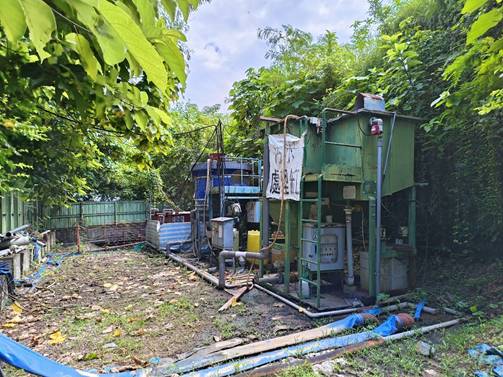
Mitigation measures for water quality protection, including the
provision of wastewater treatment facilities (with sedimentation tank and
AquaSed) and proper drainage system that separates from the WRA, have been
implemented (see Photo 1 & 2). No adverse impact on the fish pond near the
site was observed, including on the days with exceedance of water quality
parameters.
According to the results of the baseline water quality monitoring
conducted prior to the commencement of construction works, the pH recorded at
MP3 ranged from 7.7 to 8.6. The recorded pH exceedances (7.6 – 7.7) are
therefore considered to be within or close to the range of natural variations
at this location.
It is noted from AFCD's Environmental Management of Pond Fish Culture
(EMPFC) guidelines from its Series of Good Aquaculture Practice that for good
water quality DO levels should be maintained above 4 mg/L. Most of the recorded
values for DO were above the recommended minimum. Aerators were observed on all
days with DO exceedance so as to mitigate low DO levels. Nevertheless, the
Contractor was reminded to implement the water quality mitigation measures in
accordance with the recommendation stated in Section 5.6.1 - 5.6.4 of the EIA
Report as far as practicable.
It is
therefore concluded that the pH and DO exceedances at MP3 were possibly due to
localised natural variations and external factors such as pond fish culture
activities in the fishpond represented by MP3, which are not related to project
activities.
Exceedance of DO at MP4 and MP6
Exceedances of the Limit
Level of DO were observed on 16 August 2024 at MP4 and 7, 14 and 21 August 2024
at MP6. Exceedance of the Action Level of DO was observed on 12 August 2024 at
MP6.
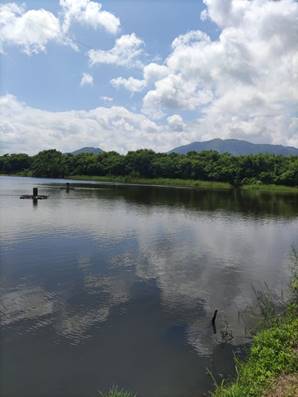
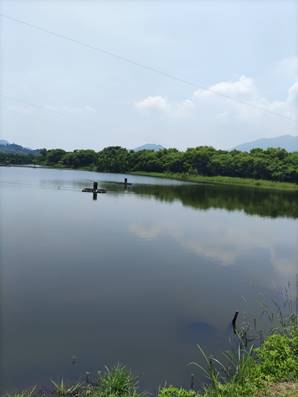
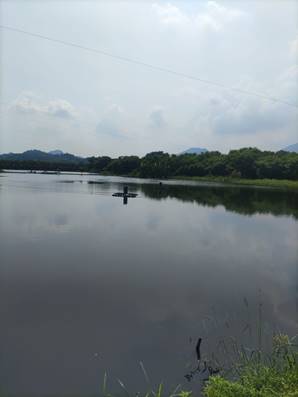
On the days of DO
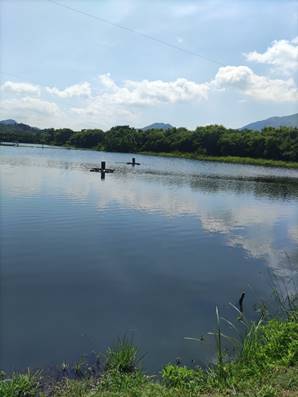
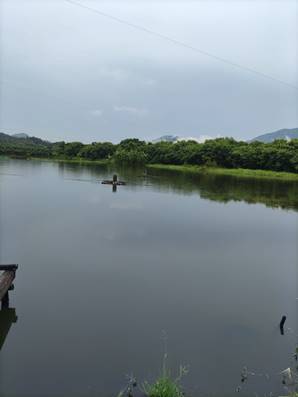
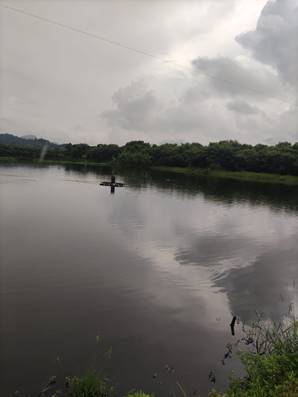
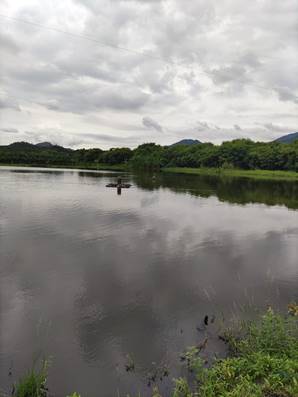
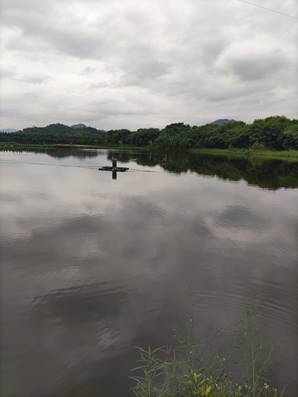
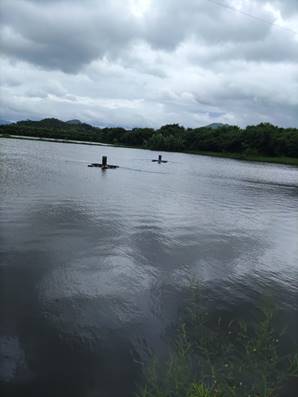
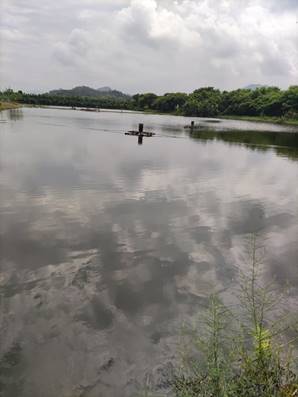
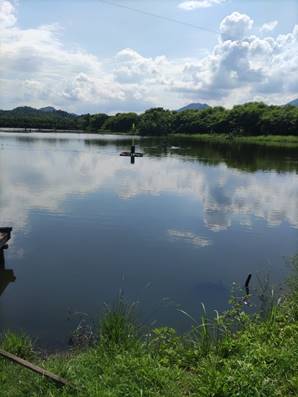
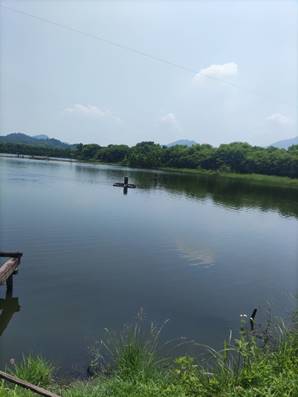
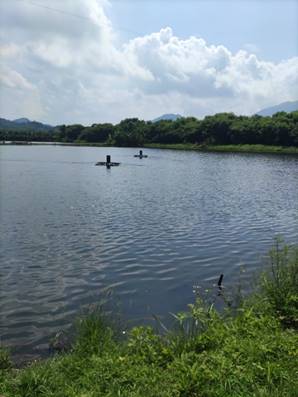
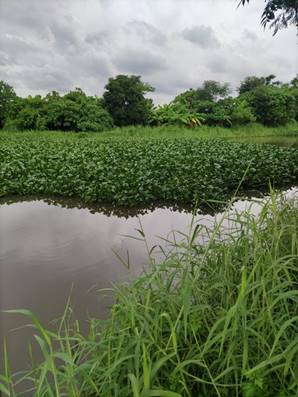
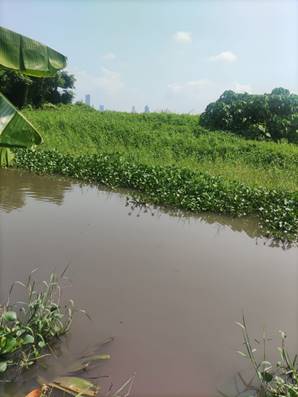
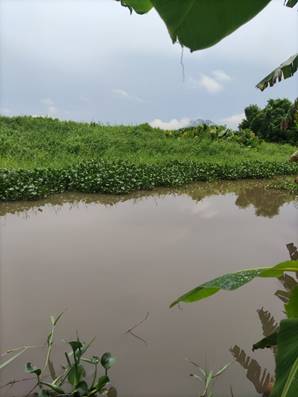
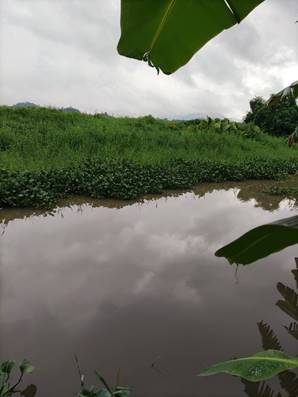
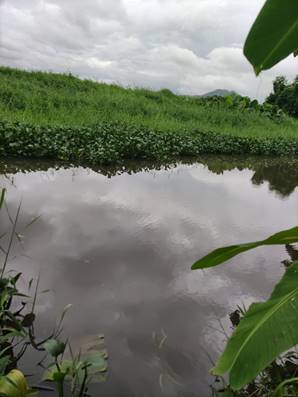
exceedances at MP4 and MP6, some growth of water plant was observed (see Photos
16-20). It is possible that excessive growth of vegetation and its degradation
may have led to a decrease in the DO level in the water. It is believed that the
DO exceedances at MP4 and MP6 were probably due to localised natural
variations, water plant growth and its degradation, and external activities
unrelated to the project.
Conclusion
As a
result, the abovementioned exceedances were unlikely to be due to the project
works and therefore not considered to be related to the project.
|
Photo 1 |
Installation of barrier at the drainage channel
to intercept site runoff and pump the wastewater to the sedimentation tanks
prior to wastewater treatment facilities (AquaSed) (near discharge outlet to
the northern ditches)
23 August 2024 |
||
|
Photo 2 |
Wastewater treatment facilities (AquaSed,
sedimentation tanks) inside the site (near discharge outlet to the northern ditches)
23 August 2024 |
||
|
Photo 3 |
Appearance of the water body at MP3 on 2 August
2024 |
||
|
|
|
||
|
Photo 4 |
Appearance of the water body at MP3 on 5 August
2024 |
||
|
|
|
||
|
Photo 5 |
Appearance of the water body at MP3 on 7 August
2024 |
||
|
|
|
||
|
Photo 6 |
Appearance of the water body at MP3 on 9 August
2024 |
||
|
|
|
||
|
Photo 7 |
Appearance of the water body at MP3 on 12
August 2024 |
||
|
|
|
||
|
Photo 8 |
Appearance of the water body at MP3 on 14
August 2024 |
||
|
|
|
||
|
Photo 9 |
Appearance of the water body at MP3 on 16
August 2024 |
||
|
|
|
||
|
Photo 10 |
Appearance of the water body at MP3 on 19
August 2024 |
||
|
|
|
||
|
Photo 11 |
Appearance of the water body at MP3 on 21
August 2024 |
||
|
|
|
||
|
Photo 12 |
Appearance of the water body at MP3 on 23
August 2024 |
||
|
|
|
||
|
Photo 13 |
Appearance of the water body at MP3 on 26
August 2024 |
||
|
|
|
||
|
Photo 14 |
Appearance of the water body at MP3 on 28
August 2024 |
||
|
|
|
||
|
Photo 15 |
Appearance of the water body at MP3 on 30
August 2024 |
||
|
|
|
||
|
Photo 16 |
Appearance of the water body at MP4 on 16
August 2024 |
||
|
|
|
||
|
Photo 17 |
Appearance of the water body at MP6 on 7 August
2024 |
||
|
|
|
||
|
Photo 18 |
Appearance of the water body at MP6 on 12
August 2024 |
||
|
|
|
||
|
Photo 19 |
Appearance of the water body at MP6 on 14
August 2024 |
||
|
|
|
||
|
Photo 20 |
Appearance of the water body at MP6 on 21
August 2024 |
||
|
|
|
4.1 Monitoring of Birds
This report documents surveys
conducted in the Survey Area between 1 and 31 August 2024. The Wetland
Restoration Area (WRA) is also surveyed as the area is accessible and site
formation works for WRA has been completed. The updated survey transect is provided
in Figure 4.1.
Dates and ecological surveys conducted during this period are summarised in Appendix
H.
Monitoring was undertaken following
the survey methodology in the EM&A Manual. A transect was followed in the
bird surveys (see Figure
4.1). All bird species were identified to species and all bird species
of conservation importance and/or wetland dependent were enumerated and
recorded to the habitats in which they were observed. Flying birds were not
recorded unless they were foraging and/or associated with the habitat (such as
swifts, swallows and birds of prey). Further, notable bird observations during other surveys or site inspections were
also recorded.
Bird surveys were conducted on a
weekly basis. A total of 30 bird species were recorded in the Survey Area
(excluding the WRA) during regular surveys in the reporting month. Among them
15 were species of conservation importance and/or wetland-dependence. Within
the WRA, 29 bird species were recorded in the reporting month. Among them 14
were species of conservation importance and/or wetland-dependence including two
of the three target species (Little Egret and Chinese Pond Heron).
The WRA attracted several species of
conservation importance in August 2024, including the Little Grebe (Tachybaptus
ruficollis), Grey Heron (Ardea cinerea), Great Egret (Ardea alba),
Little Egret (Egretta garzetta), Chinese Pond Heron (Ardeola bacchus),
Yellow Bittern (Ixobrychus sinensis), Black-crowned Night Heron (Nycticorax
nycticorax), Pied Kingfisher (Ceryle rudis) and Collared Crow (Corvus
torquatus). Little Grebe, Yellow Bittern, Black-crowned Night Heron, Pied
Kingfisher and Collared Crow are listed by Fellowes et al. as of “Local
Concern” in 2002. Grey Heron, Great Egret, Little Egret and Chinese Pond Heron
are listed by Fellowes et al. as of “Potential Regional Concern” in 2002.
A summary of survey
data is provided in Appendix
I.
4.2
Monitoring
of Herpetofauna
One nighttime herpetofauna survey
was conducted on 20 August 2024 and one day-time herpetofauna survey was
conducted on 27 August 2024. Herpetofauna recorded during other surveys or site
inspection works were recorded as ‘outside survey’.
Two species of amphibian (Asian
Common Toad Bufo melanostictus and Brown Tree Frog Polypedates
megacephalus) and one species of reptile (Bowring’s Gecko Hemidactylus
bowringii) were recorded in the Survey Area (excluding the WRA) in the
reporting month.
Within the WRA, six species of
amphibian (Asian Common Toad Duttaphrynus melanostictus, Gunther's Frog Hylarana
guentheri, Chinese Bullfrog Hoplobatrachus chinensis, Brown Tree
Frog Polypedates megacephalus, Asiatic Painted Frog Kaloula pulchra
pulchra and Ornate Pigmy Frog Microhyla fissipes) and two species of
reptile (Many-banded Krait Bungarus multicinctus multicinctus and
Bowring’s Gecko Hemidactylus bowringii) were recorded during regular
surveys. Chinese Bullfrog is listed by Fellowes et al. as of “Potential
Regional Concern” in 2002.
A summary of the survey findings is
provided in Appendix
J.
4.3
Monitoring
of Dragonflies and Butterflies
Four odonate and three
butterfly species were recorded in the Survey Area (excluding the WRA) during
regular surveys in the reporting month.
Within the WRA, 12
odonate species and eight butterfly species were recorded in the reporting
month. One additional butterfly species was recorded during outside surveys,
bringing the total number of butterfly species recorded to nine. Among the
odonate species recorded, Forest Chaser (Lyriothemis elegantissima) was
recorded for the first time in the WRA since its establishment.
A summary of the survey findings is
provided In Appendix
J.
4.4 Monitoring of Mammals
Monitoring of mammals was conducted
concurrently with other faunal surveys. Any mammal species encountered during
site inspections or other habitat management works were recorded as ‘outside
survey’.
One mammal species (Japanese
Pipistrelle Pipistrellus abramus) was recorded in the Survey Area
(excluding the WRA) and also within the WRA during regular surveys.
A summary of the survey findings is
provided in Appendix
J.
4.5
Monitoring
of Water Quality
Regular
water level monitoring works were conducted on 13 August 2024. Additional water
level monitoring was conducted on 27 August 2024 after discharging excessive
water away from the WRA.
The water
levels in the reporting month ranged between 180cm and 225cm during the water
level monitoring works.
The water levels of Cell 1, Cell 2 and Cell 4 did not reach action level in
August 2024.
The water
level of the Cells allowed wetland birds to use them as foraging sites. The
shallower areas along the edges of ponds and islets attracted ardeids such as
Grey Heron (Ardea cinerea), Great Egret (Ardea alba) as well as
the target species Little Egret (Egretta garzetta) and Chinese Pond
Heron (Ardeola bacchus). These areas were also used by other
wetland-dependent birds as foraging and/or perching sites, such as
White-breasted Waterhen (Amaurornis phoenicurus) and Common Sandpiper (Actitis
hypoleucos). The current water level will be kept for wetland bird
usage.
In-situ
water quality monitoring of all other parameters was conducted on 23 August
2024.
Monitoring
data is presented in Appendix
K. Locations for the monitoring of water quality for the ecological
monitoring are shown in Figure
4.2.
4.6
Management
Activities
4.6.1 Vegetation Management
Regular vegetation management
activities undertaken at the site in August 2024 primarily involved removal of
broken branches along the main access road, clearance of excessive grass and
exotic species along Cell bunds, main access road and open water areas of Cell
1, Cell 2, Cell 3 and Cell 4.
There were exotic Cattail (Typha
sp.) regrown in Cell 4. The regrown Cattail stands were cleared.
Fallen
leaves along the main access road of
Cell 3 and Cell 4 were swept or blown aside and formed thicker piles of plant
materials on both sides of the main access road. These piles were used to attract herpetofauna
and butterflies.
Vegetation along the main access road and the edge of Cell bunds provided foraging
and roosting habitats for breeding birds, as well as nectar sources for
butterflies and rooting sites of dragonflies. Pruning will be kept to a minimum
if the branches do not block the passage.
Plant matter and detritus
accumulated at the sluice gate of Cell 4 was cleared to facilitate water
discharge from the WRA.
4.6.2 Wildlife Management
During the site
inspection work in August 2024, no active Red Imported Fire Ant nest was
recorded. Any active nest of the Red Imported Ant identified in the following
months will be treated with AFCD approved pesticide in the coming months.
Egg masses of the
Apple Snails (Pomacea canaliculata) found along the man-made structures
of the WRA (e.g. PVC pipes, sluice gates between all Cells, concrete structures
of all Cells and concrete walls of Cell 4) were cleared by hand.
Egg masses of the Apple Snails
growing on aquatic vegetation of Cell 1, Cell 2, Cell 3 and Cell 4 were cleared
by hand. About 500 egg masses of Apple Snail were cleared.
Apple Snails were collected from aquatic
vegetation and let dry on the main access road during vegetation management
works. About 250 Apple Snails were removed.
Mitigation actions have been taken
in the WRA during the survey period to increase the WRA utilization by wetland
dependent species and birds, including:
1. Controlling the vegetation at Cell 1, Cell 2,
Cell 3 and Cell 4; and
2. Controlling the water level at Cell 1, Cell 2,
Cell 3 and Cell 4.
4.7 Summary
Ecological monitoring during August
2024 was carried out according to the survey methodology and frequency outlined
in the EM&A Manual.
A summary of the survey findings is
listed in Table 4.1:
Table 4.1:
Summary of Ecological Monitoring in WRA and Survey Area under EM&A Manual
|
Species |
Survey Area (excluding WRA) |
WRA |
|
Birds |
30 |
29 |
|
Birds
(of conservation importance and/or wetland-dependence) |
15 |
14 |
|
Amphibians |
2 |
6 |
|
Reptiles |
1 |
2 |
|
Mammals |
1 |
1 |
|
Odonates |
4 |
12 |
|
Butterflies |
3 |
9 |
Two of the three target species
Little Egret (Egretta garzetta) and Chinese Pond Heron (Ardeola
bacchus) were observed foraging along the shallow water areas (including
the edge of the Cells and non-vegetated islets) or perching on tall vegetations
within the WRA.
Dense and tall vegetations along the
edge of the main access road also attracted insectivorous birds, such as
Prinias (Prinia spp.). The vegetations also act as nighttime roosts for
diurnal birds. These vegetation stands will be kept provided that the branches
do not overgrow and obscure the main access road. During the vegetation
clearance some of these areas were only treated with minimum trimming to
preserve suitable habitats for the wildlife.
The reedbed and adjacent vegetations
(mainly Cattail stand) were used by Yellow Bittern as breeding sites according
to previous reports. Cattail (Typha sp.) is an exotic species and
requires regular clearance to prevent over growing and reducing the area of
open water and reedbed habitats. In March 2024 most of the Cattail stands
within the WRA were cleared before the breeding season of the Yellow Bittern.
The cleared area will allow more space for the growth of reedbed. In August
2024 there was some Cattail stands growing back in Cell 4. These Cattail stands
were removed during exotic species control work. Yellow Bittern was still being
observed using the reedbed of the WRA after the clearance of the Cattail.
Fallen leaves scattered along the
main access road were swept aside or blown aside and formed a thicker layer of
fallen plant materials. These piled-up plant materials are used to attract
amphibians, reptiles and butterflies within the WRA.
Site inspection works
conducted in August 2024 confirmed that all tracks and paths in the WRA were
intact and well-maintained by regular weeding and tree trimming.
Site inspection works
conducted in August 2024 confirmed that all hoarding between the construction
site and the WRA were intact.
5.1 Site Inspections
The EM&A programme for Landscape
and Visual impact due to the construction commenced in June 2010 and continued
during the reporting period. Site inspections on Landscape and Visual impact
were carried out on 9 and 23 August 2024 to confirm the implementation of
mitigation measures at the construction stage.
The Event and Action Plan for
Landscape & Visual is shown in Appendix
D.
5.2
Construction
Phase Audit Summary
The audit was undertaken with
reference to the specific checklists provided in Table
2.13 – Table 2.15 and audit results are
summarized below in Table 5.1. Representative
photos showing the implementation of mitigation measures are presented in Appendix
M.
Table
5.1: Construction and Operation Phase Audit Summary
|
Area
of Works |
Items
of be Monitored |
|
Works
Area |
The
boundaries of the works area have been established on site in accordance with
the contract documents and approved plans (EP), and the limit of current
heavy construction activity is now confined to within the site hoardings
(North side of the site / access road) and the noise barriers (other sides of
the site). Minor works such as horticultural maintenance of the planting and
transplanted trees, and boundary fence repair was proceeding along the Royal
Palms – Palm Springs boundary. (Appendix
M Photo 1 – Table 2.14 CM2
refers) No
construction works were observed to have exceeded the site boundaries.
No construction was carried out at the wetland restoration area after 15
November 2010. |
|
Protection
of all trees and woodland blocks to be retained |
Trees
retained within the site along the northeast boundary, beside wetland
restoration area, have been identified and protected by temporary protective
fencing. |
|
Streams |
The
works site is partly encircled by a berm / perimeter channel to intercept
surface water and prevent it from washing off into any of the neighbouring
sites. Surface water is collected within the site in a temporary
drainage channel. Gravels beds and barriers have been installed to
filter site runoff, sedimentation ponds have been provided to enable primary
treatment before discharge to mains drains. |
|
Clearance
of existing vegetation |
Site
clearance was completed prior to the commencement of construction. |
|
Transplanting
of trees |
Tree
transplanting has been completed, with the trees relocated to various points
within the planting strip along the southern boundary of the site, outside
the noise barrier. Most of the trees continue to re-establish well. Trees
such as tree no. A34, 54 & 291 were observed to have poor health
condition. Regular watering and close monitoring of these trees are
recommended. |
|
Topsoil
stripping |
Suitable
pond bund and soil material which had been excavated and stockpiled from the
original site, has now been re-used within the landscape works. Dust
suppression measures are active along all internal site access tracks. |
|
New
buildings |
No
new permanent buildings have yet been constructed on site. |
|
Boundaries |
Hoardings
have been erected along most of the boundaries of the site.
Installation of new screen fence between the future residential sites and the
constructed wetland restoration areas is complete. Fence has been painted
green to match with the surrounding vegetated environment. (Appendix
M Photo 1 – Table 2.14 CM2
refers) |
|
Noise
Barrier |
Noise
barriers have been installed along the southern and western boundaries of the
site in accordance with the contract requirements. Their design
complies with the mitigation requirements, with upper 6 to 7m portion of the
barrier being made from a translucent material with green tinted (to match
with the environment). Supporting GMS structure, likewise, has been painted
green. (Appendix
M Photo 3 – Table 2.14 CM6
refers). |
|
Night-time
lighting |
No
night-time works were reported to have been carried out during the monitoring
period. |
|
Landscape
and wetland treatments generally |
Continuous
belt of screen planting along the southern and western boundaries of the site
has been completed. The formation, soiling and water control structures
of the wetland restoration area have been completed. (Appendix
M Photo 3 – Table 2.14 CM6
refers) The
wetland areas have been established, with the ponds are being seasonally
filled with rainwater. Planting of areas around the WRA cells is
complete. No construction was carried out at the wetland restoration
area after 15 November 2010. (Appendix
M Photo 2 – Table 2.14 CM2
refers) |
|
Soiling,
etc. |
The
soil placement and grading for each of the wetland restoration areas has been
completed. Refilling for those holes left after the whole tree removal works
has been completed. |
|
Plant
supply |
The
plant material used in the Advance Planting Strip and in the WRA are all
commonly available species and came from commercial sources. Transplanted
reeds (Phragmites australis) at the wetland habitat came from the
temporary holding nursery onsite. |
|
Planting |
The tree
species are all from the approved list. Seedling trees and shrubs have
been established at the margins of the wetland cells. Some invasive species
and undesirable exotic species have been found during site inspection;
removal of these species should be undertaken on a regular basis. |
|
Establishment Works |
The advance planting, the compensatory planting
and transplanted trees are generally being maintained by the landscape
sub-contractor in accordance with the specification to ensure that the
contract requirements are met. Tree no. 56, 59, 71, 277 and 292 were removed
due to safety concern. Cracks were observed on tree nos. 311, 398 and
407. Appropriate treatments such as pruning or tree removal are recommended. Signs of presence of termites were observed on
tree no. 332. Application of pesticide and close monitoring of the trees are
recommended. Removal of overgrown weeds, unplanned tree
seedlings and invasive climbers in the space behind screen noise barrier
needs to be undertaken on a monthly basis as they may inhibit the advance
planting. Regular removal of invasive species (i.e.,
apple snails, Leucaena leucocephala, Mikania micrantha, Mimosa pudica,
Bidens alba, Ludwigia erecta, Sesbania cannabina, etc.) in WRA should be
undertaken. The growth of shrubs / seedlings on the north
side of the WRA remains fair. |
6.1 Site Inspection
The ET had carried out construction
phase weekly site inspections on 1, 9, 15, 23 and 30 August 2024. All
observations have been recorded in the site inspection checklist and passed to
the Contractor together with the appropriate recommended mitigation measures
where necessary. The key observations from site inspections and associated
recommendations are summarized in Table 6.1.
Table
6.1: Summary of Site Inspections and Recommendations
|
Key
Observations |
ET
Recommendation |
Contractor’s
Responses / Action(s) Undertaken |
Close-out
(Date) |
|
Nil |
|
|
|
6.2
Solid
and Liquid Waste Management Status
The Contractor has been registered
as a chemical waste producer for the Project. Construction and demolition
(C&D) material sorting was carried out on site. A sufficient number of
receptacles were available for general refuse collection.
As advised by the Contractor, no
inert C&D material (i.e. broken concrete/ big boulders) were generated on
site and sent to a sorting facility for recycling into rockfill. No metals were
generated and collected by registered recycling collector. No paper/cardboard
packing and no plastics were generated on site and collected by registered
recycling collector. No chemical waste was generated and collected by licensed
chemical waste collector. No other types of wastes (e.g. general refuse) were
generated on site and disposed of at public landfill facility.
The Contractor is advised to
maintain on site waste sorting and recording system and maximize reuse /
recycling of C&D wastes, whenever these are generated.
6.3
Status
of Environmental Licences and Permits
The environmental permits, licences,
and/or notifications on environmental protection for this Project which were
valid during the reporting period is summarised in Table
6.2.
Table
6.2: Status of Environmental Submissions, Licences and Permits
|
Statutory
Reference |
Description |
Permit/Reference
No. |
Status |
|
EIAO |
Environmental
Permit |
EP-311/2008/E
|
Valid |
|
APCO |
Notification
of Construction Work under APCO |
2018-027-A-1
(20 July 2020) |
Valid |
|
WPCO |
Discharge
Licence |
WT00037436-2021
(21 Apr 2021) |
Valid |
|
WDO |
Registration
as Chemical Waste Producer |
WPN0000-542-H3083-04 |
Valid |
|
WDO |
Bill
Account for Disposal |
700945423 |
Valid |
Legend:
EIAO – Environmental Impact Assessment Ordinance; APCO – Air Pollution Control
Ordinance; WPCO –Water Pollution Control Ordinance; WDO – Waste Disposal
Ordinance
6.4
Recommended
Mitigation Measures
The EM&A programme followed the
recommended mitigation measures in the EM&A Manual. The EM&A
requirements as well as the summary of implementation status of the
environmental mitigation measures are provided in Appendix
L. In particular, the following mitigation measures continue to be
implemented at the site:
Air Quality
● Access roads should be sprayed with
water or dust suppression chemical to maintain the entire road surface wet or
paved.
Water Quality
● Site effluent should be discharged
in accordance with the discharge licence.
● The site should be confined and
properly maintained to avoid silt runoff.
● Chemicals will always be stored on
drip trays or in bunded areas.
Waste Management
● The chemical waste storage area
should be clearly labelled.
● General refuse should be stored in
enclosed bins or compaction units separate from C&D and chemical wastes.
7.1 Record of non-compliance of Action
and Limit Levels
There was no breach of Action or
Limit Levels for Air Quality and Noise monitoring in the reporting month.
A summary is presented in Table 7.1
below.
Table 7.1: Summary of Exceedances in Water
Quality
|
Monitoring Date |
pH |
Dissolved Oxygen (DO) (mg/L) |
Turbidity (NTU) |
Suspended Solids (mg/L)(1) |
|
MP3 |
|
|
|
|
|
02/08/2024 |
7.4 |
4.8 |
3.9 |
4 |
|
05/08/2024 |
7.6 |
6.3 |
4.4 |
4 |
|
07/08/2024 |
7.4 |
5.5 |
4.7 |
6 |
|
09/08/2024 |
7.2 |
6.0 |
6.1 |
7 |
|
12/08/2024 |
7.1 |
5.1 |
6.5 |
7 |
|
14/08/2024 |
7.3 |
5.0 |
6.4 |
7 |
|
16/08/2024 |
7.4 |
3.0 |
5.8 |
5 |
|
19/08/2024 |
7.3 |
4.5 |
7.5 |
10 |
|
21/08/2024 |
7.5 |
5.0 |
5.3 |
6 |
|
23/08/2024 |
7.4 |
5.3 |
5.3 |
6 |
|
26/08/2024 |
7.5 |
6.0 |
5.0 |
5 |
|
28/08/2024 |
7.7 |
4.8 |
6.2 |
6 |
|
30/08/2024 |
7.2 |
5.4 |
5.2 |
7 |
|
Action
Level |
<5.5
or >7.5 |
<6.85 |
>64 |
>65 |
|
Limit
Level |
<4.0
or >8.0 |
<6.65 |
>67 |
>66 |
|
MP4 |
|
|
|
|
|
16/08/2024 |
7.0 |
3.8 |
31.7 |
29 |
|
Action
Level |
<5.5
or >7.5 |
<3.91 |
>60 |
>50 |
|
Limit
Level |
<4.0
or >8.0 |
<3.82 |
>64 |
>53 |
|
MP5 |
|
|
|
|
|
Action
Level |
<5.5
or >7.5 |
<4.13 |
>81 |
>66 |
|
Limit
Level |
<4.0
or >8.0 |
<3.87 |
>84 |
>69 |
|
MP6 |
|
|
|
|
|
07/08/2024 |
6.9 |
4.1 |
27.9 |
40 |
|
12/08/2024 |
7.0 |
4.6 |
34.6 |
44 |
|
14/08/2024 |
7.0 |
4.2 |
35.1 |
38 |
|
21/08/2024 |
6.9 |
4.4 |
14.9 |
18 |
|
Action
Level |
<5.5
or >7.5 |
<4.61 |
>94 |
>75 |
|
Limit
Level |
<4.0
or >8.0 |
<4.52 |
>96 |
>75 |
Notes:
(1) “<2”: Value
is too low to indicate (<2mg/L).
(2) For the Limit Level
of DO, 1-percentile of baseline data is adopted as it is greater than 2mg/L.
(Refer to Baseline
Monitoring Report)
(3) Values in Bold
indicate Action Level exceedance.
(4) Values Underlined
and in Bold indicate Limit Level exceedance.
7.2 Record on Environmental Complaints Received
No environmental complaint was
received during the reporting month.
7.3
Record
on Notifications of Summons and Successful Prosecution
No notifications of summons or
successful prosecution were received the reporting month.
7.4
Review
of Reasons for and Implications of Non-compliance, Complaints, Summons and
Prosecutions
Non-compliance
Investigations have been carried out
to identify the causes of the water quality exceedances.
The investigation findings are
presented in Section 3.2.3.1. It was concluded that the above-mentioned
exceedances were unlikely to be due to the construction works and therefore not
considered to be related to the project.
Complaints,
Summons and Prosecutions
Not applicable for this reporting
month.
7.5
Follow-up
Actions Taken
Non-compliance
The Event and Action Plan has been
followed. Although it is considered that the exceedances were not related to
the Project, the Contractor was reminded to implement the water quality
mitigation measures in accordance with the recommendation stated in Section
5.6.1 – 5.6.4 of the EIA Report as far as practicable, regular spot checks
would be conducted on the nearby discharge by the Contractor and he would
inform the ET for investigation.
Complaints,
Summons and Prosecutions
Not applicable for this reporting
month.
7.6
Cumulative
Statistics for Complaints, Notifications of Summons and Successful Prosecutions
Cumulative statistics for
complaints, notifications of summons and successful prosecutions for the
Project account for period starting from the date of commencement of
construction (i.e., 12 May 2010) to the end of the reporting month and are
summarized in Table 7.2 below.
Table
7.2: Statistics for Complaints, Notifications of Summons and Successful
Prosecution
|
Reporting
Period |
Cumulative Statistics |
||
|
Complaints |
Notifications of
Summons |
Successful
Prosecutions |
|
|
This
reporting month (August 2024) |
0 |
0 |
0 |
|
From 12
May 2010 to end of the reporting month (August 2024) |
8 |
0 |
0 |
8.1 Site Preparatory Works and
Construction Works for the Coming Month
Site works to be commissioned in the
coming month include:
● Regular maintenance work for the
Wetland Restoration Area (including adjusting the water level, if required, and
removal of unwanted species in the pond)
● No heavy construction works
8.2
Key
Issues for the Coming Months
Key issues to be considered in the
coming three months include:
● Provision of water spraying or dust
suppression chemical to prevent generation of dust from activities on-site and
the haul road during dry weather conditions;
● Provision of wheel washing
facilities at vehicle exit point;
● Generation and treatment of site
surface runoffs and wastewater from activities on-site and during wet weather
conditions;
● Sorting, recycling, storage and
disposal of general refuse and construction waste from activities on-site; and
● Management of chemicals and
avoidance of oil spillage on-site and to the drainage system.
8.3
Monitoring
Schedule for the Coming Month
The environmental site inspection
and environmental monitoring will be continued in the coming month.
Impact monitoring for air, noise, water quality, ecology and landscape and
visual in accordance with the approved EM&A Manual has commenced since 12
May 2010. The tentative monitoring schedule for September 2024 is shown in the Table 8.1.
Table
8.1: Tentative Environmental Monitoring and Audit Schedule for the Next
Reporting Month
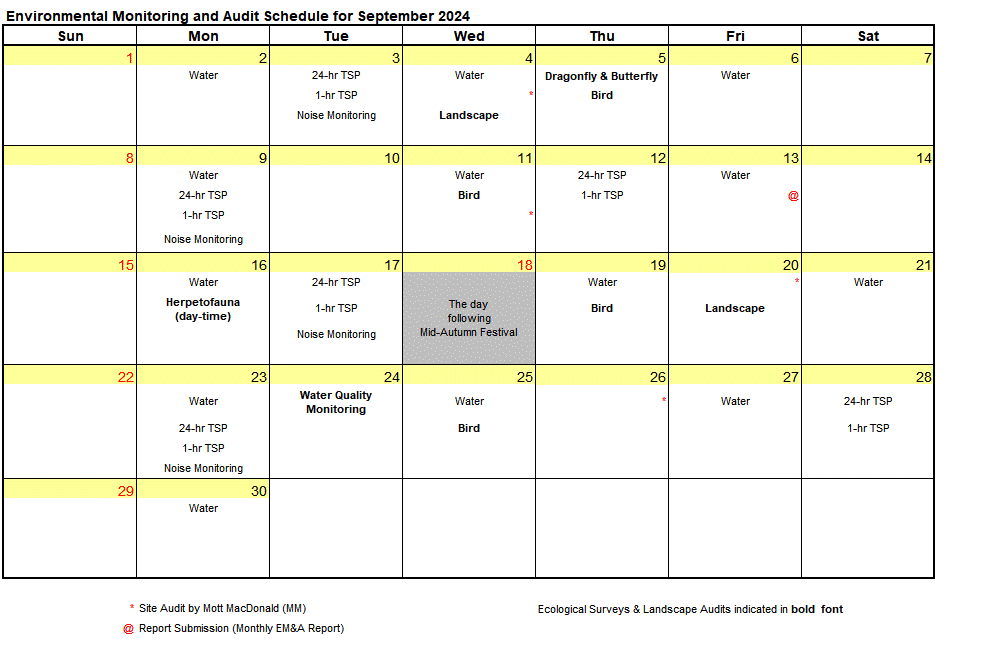
8.4 Conclusions and Recommendations
8.4.1 Conclusions
The EM&A programme as
recommended in the EM&A manual has been undertaken in the reporting month
since 12 May 2010.
Monitoring of Air Quality, Noise,
Water Quality, Ecology and Landscape and Visual impacts due to the Project was
under way. In particular, the 1-hr TSP, 24-hr TSP, noise level (as Leq)
and water quality parameters (such as pH, DO, turbidity and SS) under
monitoring have been checked against established Action and Limit levels.
There was no breach of Action or
Limit Levels for Air Quality and Noise monitoring in the reporting month.
During August 2024, a total of one
Action Level exceedance of DO, 17 Limit Level exceedances of DO and two Action
Level exceedances of pH were observed for water quality. Two Action Level
exceedances of pH and 13 Limit Level exceedances of DO were recorded at MP3;
one Limit Level exceedance of DO was recorded at MP4; three Limit Level
exceedances of DO and one action level exceedance of DO were recorded at MP6.
8.4.2 Recommendations
With considerations on the
construction activities and environment, the following recommendations were
provided:
Air Quality
● All stockpiles should be covered by
tarpaulin or kept wet by water spraying;
● All vehicles should be washed to
remove any dusty materials before leaving the construction sites;
● The portion of road leading the
construction site that is within 30m of a designated vehicle entrance or exit
should be kept clear of dusty materials;
● During the dry season, sufficient
water spraying should be provided at haul road to reduce dust emission; and
● Ensure proper functioning of the
wheel wash facility.
Noise
● Mobile plant should be sited as far
away from NSRs as possible;
● Plant known to emit noise strongly
in one direction should be orientated to direct noise away from the NSRs; and
● The construction activities should
be better scheduled to reduce noise nuisance.
Water Quality
● Effluent should be discharged in
accordance with the discharge licence conditions;
● Soil contaminated with
chemicals/oils should be removed from site and the voids should be created
filled with suitable materials; and
● Silt and debris should be removed
from the temporary drainage channel regularly.
Waste Management
● General refuse should be stored in
enclosed bins or compaction units separate from C&D and chemical wastes to
minimise odour, pest and litter impacts.
● Reuse the excavated materials as far
as practical to reduce the amount of waste disposal;
● C&D waste should be segregated
and stored in different containers to other wastes to encourage the re-use or
recycling of materials and their proper disposal;
● Ensure drip trays are provided for
chemical containers to prevent leakage or soil contamination;
● All plants and vehicles should be
properly maintained to prevent oil leakage; and
● Oil stains on soil should be cleared
by disposal of contaminated soil.
9
References
9.1
List
of References
Agriculture, Fisheries and Conservation
Department. 2019. Hong Kong Biodiversity Database. https://www.afcd.gov.hk/english/conservation/hkbiodiversity/database/popup_record.php?id=748,
2019 -07-09
BirdLife International.
2017. Important Bird Areas factsheet: Inner Deep Bay and Shenzhen River
catchment area. <http://www.birdlife.org> on 06/07/2017.
Carey, G. J., Chalmers,
M. L., Diskin, D. A., Kennerley, P. R., Leader, P. J., Leven, M. R.,
Lewthwaite, R. W., Melville, D. S., Turnbull, M., and Young, L. 2001. The
Avifauna of Hong Kong. Hong Kong Bird Watching Society, Hong Kong.
Chan, S.K.F., K.S.
Cheung, C.Y. Ho, F.N Lam & W.S. Tam, 2005. A Field Guide to the
Amphibians of Hong Kong. Cosmos Books Ltd., Hong Kong.
Fellowes, J.F., M.W.N. Lau, D. Dudgeon, G.T.
Reels, G.W.J. Ades, G.J. Carey, B.P.L. Chan, R.C. Kendrick, K.S. Lee, M.R.
Leven, K.D.P. Wilson, Y.T. Yu, 2002.Wild Animals to Watch: Terrestrial and
Freshwater Fauna of Conservation Concern in Hong Kong. Memoirs of the
Hong Kong Natural History Society 25:122-159.
Hong Kong Biodiversity Information
Hub.
<https://bih.gov.hk/en/species-database/index.html?taxon_group_id=4>
Hong Kong Bird Watching Society 2020. List of
Hong Kong Birds - 2020-03. <www.hkbws.org.hk>.
Hong Kong Observatory Climate
Information Service. <https://www.hko.gov.hk/en/wxinfo/pastwx/mws/mws.htm>
Horiuchi, S., Odawara, T.,
Yonemura, S., Hayashi, Y., Kawaguchi, M., Asada, M., Kato, M. & Yasuhara,
K. (2007, November). Floating structure using waste tires for water environmental
remediation. In Scrap Tire Derived Geomaterials-Opportunities and Challenges:
Proceedings of the International Workshop IW-TDGM 2007. p. 291. CRC Press.
IUCN 2023. IUCN Red List of Threatened
Species. Version 2023-7. <www.iucnredlist.org>. Downloaded on 1st
July 2023
Karsen, S., M.W.N. Lau &
A. Bogadek, 1998. Hong Kong Amphibians and Reptiles. Provisional Urban Council, Hong
Kong.
List of National Protected Animal
(updated on 5 Feb 2021) http://www.gov.cn/xinwen/2021-02/09/5586227/files/e007df5cdb364bcdbcb89d169047d6c5.pdf
Lo, P. Y. F. and W.L. Hui,
2004. Hong
Kong Butterflies. Hong Kong, Cosmos Books Ltd.
Mott, 2008. WSW
Environmental Monitoring and Audit Manual (March 2008).
Mott, 2008. WSW
Environmental Impact Assessment Report Volumes 1 to 3 (March 2008).
Mott, 2008. WSW Wetland
Restoration Plan (March 2008).
Shek, C. T. 2006. A
Field Guide to the Terrestrial Mammals of Hong Kong. Friends of the Country
Parks Cosmos Books Ltd., Hong Kong.
Tam, T.W., K.K. Leung,
B.S.P. Kwan, K.K.Y. Wu, S.S.H. Tang, I.W.Y. So, J.C.Y. Cheng, E.F.M. Yuen, Y.M.
Tsang, and W.L. Hui, 2011. The Dragonflies of Hong Kong (1st
edition). Agriculture, Fisheries and Conservation Department, Friends of
Country Parks and Cosmos Books Ltd., Hong Kong.
Wilson, K.D.P., Tam,
T.W., Kwan, B.S.P., Wu, K.K.Y., Wong, B.S.F., Wong J.K. 2004. Field Guide to
the Dragonflies of Hong Kong. AFCD, Friends of Country Park and Cosmos
Books Ltd. Hong Kong.
Young, J.J. & Yiu, V., 2002. Butterfly
Watching in Hong Kong. Wan Li Book Co. Ltd., Hong Kong.
Zheng Guangmei and Wang Qishan
(1998) (Edited), China Red Data Book of Endangered Animals: Aves,
Science Press, Beijing.